Reader’s Note
Very good lecturer, no archive.
by@theodore_pWritten 20 August 2026Read 17 August 2026
Because four separate people asked me about this book in a single term, including a colleague in economics who ought to know better than to take his history from a man with no archive, I finally read it properly, pencil in hand, which is the only way I know how to read.
The first third is genuinely good. I want to say that clearly, because most of what follows is complaint and I don't want the complaint mistaken for dismissal. The account of the Cognitive Revolution, and specifically the argument that our species runs on shared fictions, is put with real clarity and real force. Money, nations, limited liability companies, human rights: imagined orders, all of them, and load-bearing precisely because enough of us agree to imagine them together. Not an original thesis. Anderson said much of it about nations in 1983 and Searle said much of it about institutions in 1995. Neither of them could write a paragraph a bus passenger would finish, and Harari can, and I refuse to pretend that isn't a skill.
Where it goes wrong
The trouble begins when the confidence outruns the evidence, which happens at roughly the Agricultural Revolution and never really stops.
"History's biggest fraud" is a wonderful chapter title and a fairly bad argument. The claim is that farming made individual lives worse while making the species more numerous, and there is something in it; Jared Diamond made the same case in an essay in 1987 and hedged it far more carefully. Harari doesn't hedge. He asserts, moves on, and by the time you have assembled your objection he is three thousand years further down the road describing something else with identical unbothered certainty. Chapter after chapter does this. The Scientific Revolution section treats the entanglement of empire and science as though it were a discovery rather than a commonplace of the last forty years of scholarship, and cites almost nobody for it.
That last point is the one I can't let go. There is a bibliography, but the notes are thin to the point of decorative, and for long stretches you simply cannot tell whether a claim is settled consensus, live dispute, or the author's own hunch. The prose does not distinguish between them. It has one register, calm and faintly amused and addressed to you as a fellow adult who has seen through things, and that register is applied identically to radiocarbon dates and to speculations about what foragers felt at dusk.
The apparatus, briefly
Mine is the Vintage paperback with the beige cover and the fingerprint motif. Typesetting is fine. Who decided the endnotes should be gathered at the back without running heads? Whoever it was has never chased an endnote in anger. Two bookmarks, every time, for a book that already asks a lot of a general reader's patience.
Where I land
Six, and I mean a real six rather than a polite one. The book is doing something valuable and doing it slightly dishonestly. Valuable, because no other single volume will give a curious non-specialist a scaffold on which to hang everything they subsequently read, and a scaffold is not nothing. Dishonest, because it presents that scaffold as though every beam had been load-tested, when a fair number of them are opinions the author holds with vigour.
The reader who has come here from a recommendation algorithm should know what they're buying: a very good lecturer's version of the past, delivered by somebody who has never had to sit in a room while a specialist takes his third chapter apart. That is a genuine pleasure. Which is also why the closing material on happiness and the future reads like someone extending a run of good luck. He is out past his evidence and he knows it, and rather than slow down he accelerates.
I have lent it twice, both times with a caveat, which is a thing I don't have to do with Tuchman or Cipolla or even Bryson, who at least has the grace to sound uncertain when he is.
If you read it, follow it with something narrow. A monograph on one century, footnotes you can chase, an author who says "probably" now and then. The students who did that came back with much better questions than the ones who didn't.
About this book
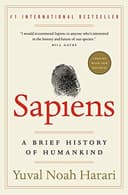 SapiensYuval Noah Harari
In the Margins
Sapiens reviewed by @the_slow_reader
In Spanish it's called De animales a dioses, a much better title. The first third, fine. After that he's explaining to me things which I already knew, and other things which I don't think he knows either. Has anyone checked the middle third?6 out of 10@the_slow_reader
Sapiens reviewed by @kepler22b
readable, broad, sourced thin. why is a book this confident about the cognitive revolution so vague in the notes? fine as a way in / not a reference.7 out of 10@kepler22b
Sapiens reviewed by @mx_marginalia
Everyone told me this was history. It's a confident essay about history, a different object entirely, and it keeps getting graded on the wrong curve.4 out of 10@mx_marginalia
The Reading Room
More from @theodore_p
Tinker Tailor Soldier Spy reviewed by @theodore_p
Smiley reconstructing an old file in a rented room beats any car chase ever filmed. The real subject is institutional decline and the spying is only how it gets delivered. Fifty pages of tradecraft vocabulary, and then you simply have it.9 out of 10Tinker Tailor Soldier Spy
Letters from a Stoic reviewed by @theodore_p
Campbell's selection, not the complete letters. That matters.8 out of 10Letters from a Stoic
One Hundred Years of Solitude reviewed by @theodore_p
The genealogy chart at the front is a confession of a design problem.8 out of 10One Hundred Years of Solitude
2 readers agree with this review