Reader’s Note
Everyone told me this was history. It's a confident essay about history, a different object entirely, and it keeps getting graded on the wrong curve.
by@mx_marginaliaWritten 19 June 2026Read 17 June 2026
How do you argue with a book that has already won? Everyone I know has read it. Two people in my club gave it to their parents. It gets described as the best history written this century, and I'll be careful here, because my complaint isn't that it's wrong. My objection is about what kind of object it is.
Call it what it is: a long essay. Essays make arguments, select their evidence, and move fast, because the pleasure of an essay is momentum. History does the opposite. It slows down at exactly the point where the evidence thins out, and it tells you the question is contested. These chapters almost never slow down. Whole disputes that occupy scholars for entire careers get one confident paragraph and a good line — then we're off to the next millennium. If you already know the underlying literature you can feel the gaps like potholes. If you don't, and most readers don't, you finish with the sensation of having been taught something, which is not the same as having been taught something.
The cognitive revolution section is where this bites hardest. His claim that shared fictions are what let large numbers of strangers cooperate is genuinely good, and I'd defend it in any room. But it arrives as settled, and it isn't; it's one live position among several, and you would never know that from the prose. Money, nations, limited companies, human rights: the same move, four times, always elegant, never qualified.
Here's the counter-argument, and it came from Deborah, who reads far more archaeology than I do. She says the register is deliberate. It's meant to be a book a person finishes on a commute, and finishing it makes them go and read three harder ones afterwards. That's a genuinely valuable thing to be, and snobbery about it costs the world readers. I accept the point entirely. I'd add that the agriculture material is the strongest passage he writes, precisely because it's where he does slow down.
Which brings me to correcting myself in public. I told our group he argues agriculture was a mistake. He doesn't. He argues it was a trap, that it fed more people worse, and that wheat did as much domesticating as we did. That's a sharper claim than the one I put in his mouth, and it happens to be the one I agree with. Give me a whole book of just that.
The back third is where the four settles and stays. His speculation about happiness leans on studies I've watched wobble badly over the last decade, and the futurism at the close reads like a conference keynote. There's a difference between a historian looking forward with caution and a very fluent man enjoying the sound of his own conclusions.
Four. Not because it's bad, but because the gap between what it is and what it gets treated as has become a problem of its own, and somebody at my table has to say so.
About this book
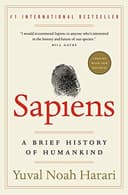 SapiensYuval Noah Harari
In the Margins
Sapiens reviewed by @theodore_p
Very good lecturer, no archive.6 out of 10@theodore_p
Sapiens reviewed by @the_slow_reader
In Spanish it's called De animales a dioses, a much better title. The first third, fine. After that he's explaining to me things which I already knew, and other things which I don't think he knows either. Has anyone checked the middle third?6 out of 10@the_slow_reader
Sapiens reviewed by @kepler22b
readable, broad, sourced thin. why is a book this confident about the cognitive revolution so vague in the notes? fine as a way in / not a reference.7 out of 10@kepler22b
The Reading Room
More from @mx_marginalia
Atomic Habits reviewed by @mx_marginalia
Two stars, and I'll defend them.2 out of 10Atomic Habits
Stoner reviewed by @mx_marginalia
Slower than its own legend.7 out of 10Stoner
The Secret History reviewed by @mx_marginalia
Great novel, and it stops halfway.6 out of 10The Secret History