Reader’s Note
The genealogy chart at the front is a confession of a design problem.
by@theodore_pWritten 18 August 2026Read 18 August 2026
Seventeen Aurelianos. Two José Arcadios a generation, occasionally three, plus an Arcadio, plus an Aureliano José for good measure. My edition prints a family tree opposite the title page, and I want to be clear that I don't consider this cheating; I consider it an admission. A novel that requires a diagram to be followed has made a choice, and I spent a week deciding whether the choice was brave or evasive, and I've landed on brave, mostly, with a residue of irritation that accounts for the eight.
What is genuinely extraordinary
The opening sentence gets quoted to death and deserves to be, though not for the reason usually given. It isn't the firing squad. It's the three tenses. A future recollection of a distant past delivered in a single clause, and the entire temporal method of the novel is announced before you have finished the first line. I have been teaching prose for twenty-six years and I know of perhaps four openings that do that much work that fast.
Then the ice. Then the insomnia plague and the loss of memory, and Macondo labelling every object in the village with its name and its use so that the words survive after the meanings have gone. That sequence is the best thing here and it is also the most eighteenth-century thing here, which is my hobbyhorse, so bear with me. It is a Swiftian conceit executed with a warmth Swift never possessed. The Academy of Lagado would have adored those labels. Swift would have used them to humiliate somebody. García Márquez uses them to grieve.
The banana company massacre, and afterwards the official insistence that nothing happened and there were no dead and there had never been a company, is the passage that moved me from admirer to something stronger. Three thousand bodies on a train and a country agreeing to have forgotten. He is reporting, barely fictionalised, and the whole apparatus of the marvellous suddenly reveals itself as the only register in which the actual events could be set down without being disbelieved.
What wears
Repetition is the point, I do understand. The names recur because the family recurs because history in this account is a circle rather than a line. Fine. But a technique that is thematically justified can still be exhausting to read, and around the fourth generation I stopped being able to hold the distinctions and started flipping to the chart, and flipping to a chart is not reading. Some of that is on me. Some of it is on a book that demands a level of attention it doesn't consistently reward.
The women fare oddly. Úrsula is magnificent and Amaranta is a real and terrible creation, but the younger generations arrive largely as bodies for men to be destroyed by, and Remedios the Beauty ascending into the sky with the laundry is a lovely image attached to a character with no interior whatever. Pilar Ternera and Petra Cotes come off considerably better. The pattern is still there, and Úrsula on her own is not a defence of it.
Translation and edition
Gregory Rabassa's English is what I know, and by all accounts the author preferred it to his own Spanish, a remark I have always found slightly suspicious and entirely charming. There is a newer translation about which I can say nothing, not having read it.
What I would say to anybody buying: skip the introduction. Every edition I have handled has one, and every single one summarises the ending, including the parchments, including Aureliano reading his own family's history in Melquíades's room while the wind takes the house. I found out that way in 1993, standing in a shop, and I have never entirely forgiven the Picador of that year.
Eight, then. It is a great novel and I'm not going to pretend otherwise because I got lost among the Aurelianos. But greatness and pleasure are different measures. I have gone back to the insomnia chapters four or five times and to the middle of the book precisely never.
If you're starting it, keep the chart open, stop fighting the repetition, and give yourself long sittings. It punishes the twenty-minute read on a train more than anything else I can think of.
About this book
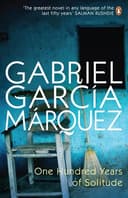 One Hundred Years of SolitudeGabriel García Márquez
In the Margins
One Hundred Years of Solitude reviewed by @pageandvine
I drew the family tree on the back of an envelope and still lost track8 out of 10@pageandvine
One Hundred Years of Solitude reviewed by @mossandink
I kept a list of the Aurelianos in the back and lost it twice. Yellow butterflies, insomnia, ice; I'd take the ice chapter over most novels I read this year. Read it right through the drought, which probably helped, or possibly ruined it.9 out of 10@mossandink
One Hundred Years of Solitude reviewed by @the_slow_reader
In the original, obviously.9 out of 10@the_slow_reader
The Reading Room
More from @theodore_p
Tinker Tailor Soldier Spy reviewed by @theodore_p
Smiley reconstructing an old file in a rented room beats any car chase ever filmed. The real subject is institutional decline and the spying is only how it gets delivered. Fifty pages of tradecraft vocabulary, and then you simply have it.9 out of 10Tinker Tailor Soldier Spy
Sapiens reviewed by @theodore_p
Very good lecturer, no archive.6 out of 10Sapiens
Letters from a Stoic reviewed by @theodore_p
Campbell's selection, not the complete letters. That matters.8 out of 10Letters from a Stoic