Reader’s Note
Nobody reads the appendix, which is written in the past tense by somebody living after Ingsoc has fallen, and that changes the novel's last line.
by@theodore_pWritten 27 March 2026Read 26 March 2026
Nobody in my third-year group had read the appendix. They had all read the novel, several of them twice, and not one had turned to "The Principles of Newspeak" at the back, because it looks like apparatus and they have been trained since sixteen to skip apparatus. So we read it aloud, and about a page in, Bethan stopped me and asked why it was in the past tense.
That is the moment I teach this book for. The appendix is written by a scholar, after Ingsoc, looking back at a dead language. Whoever wrote it is free. The novel ends with Winston loving Big Brother and then, if you keep going, the state has fallen and somebody is writing academic prose about its grammar. Orwell put the hope in the one place a despairing reader would never look, and he put it in the register of a footnote, which is either the driest joke in English fiction or not a joke at all. I have never quite decided.
On the prose
People praise this novel for its ideas and undersell its sentences, which annoys me. Look at Part One, chapter 2, when Winston goes next door to the Parsons flat: boiled cabbage, the mat, the child with the toy pistol. Four or five physical details and not one adjective straining. The whole century learned dystopia from this and mostly reproduced the ideas without noticing that the ideas only bite because the flat smells right.
Swift is the ancestor, though not in the way people reach for. It is the plain reporting voice describing an atrocity at the same pitch as a breakfast. Swift does it better in the Modest Proposal, but Swift only had to hold it for a few pages and Orwell holds it for a novel.
On what everyone gets wrong
Two things, actually.
The first is the assumption that this is a book about surveillance. It isn't, or not chiefly. The telescreen is furniture; the machinery that destroys Winston is linguistic and epistemic. He is broken by being made to say four when he sees five, and then by being made to see five. Cameras are the least frightening thing in it. Every essay I mark that treats the novel as a prophecy about CCTV has stopped at the furniture.
The second is O'Brien. Students want him to be lying about the boot and the face forever; they want a hidden motive, a secret cynicism, some concealed venality that would make him legible. He hasn't got one. That is the idea they resist longest, and it is why the torture sequence, which is long and repetitive and which I have heard called self-indulgent, has to be long and repetitive. You cannot arrive at that idea quickly.
Editions
Mine is a 1954 Secker reprint that belonged to my father, boards gone soft, and I've not managed to read another copy with the same attention, which I concede is sentiment rather than scholarship. The recent Penguin with the redacted-title cover is a handsome piece of design and a slightly annoying object; the black bars run onto the spine, so you can't find it on a shelf. If you are buying one to keep, get anything that prints the appendix in the same type size as the novel. Several don't. Setting it smaller tells the reader it's optional, and it isn't. And if you are buying secondhand, check the appendix is present at all — a schools edition I was handed to teach from in the nineties had dropped it entirely, presumably to save a signature, and nobody in the department had noticed in eleven years.
I have taught this eleven times and I have not got bored of it, which I can say of perhaps four books. Every year a student arrives certain it is about their own government, and every year the certainty attaches to a different government, and the novel absorbs it without deforming. Books that flexible are usually vague. This one is precise about everything and flexible anyway, and I don't fully understand the mechanism.
Ten. Not because it is flawless, since the Julia sections sag and the Goldstein tract in the middle is a real test of patience on a first reading, but because I have never found a better thing to hand a nineteen-year-old who has just worked out that language can be used against them.
About this book
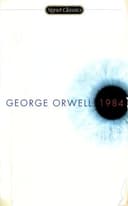 Nineteen Eighty-fourGeorge Orwell
In the Margins
Nineteen Eighty-four reviewed by @an_ordinary_tuesday
A Warning carved in cold stone.6 out of 10@an_ordinary_tuesday
5 readers agree with this reviewNineteen Eighty-four reviewed by @bleakhouse_bex
Everyone calls it political. It's a horror novel.9 out of 10@bleakhouse_bex
6 readers agree with this reviewNineteen Eighty-four reviewed by @verity_lane
Yes I've read it now. No, I'm not discussing it.7 out of 10@verity_lane
The Reading Room
More from @theodore_p
Tinker Tailor Soldier Spy reviewed by @theodore_p
Smiley reconstructing an old file in a rented room beats any car chase ever filmed. The real subject is institutional decline and the spying is only how it gets delivered. Fifty pages of tradecraft vocabulary, and then you simply have it.9 out of 10Tinker Tailor Soldier Spy
Sapiens reviewed by @theodore_p
Very good lecturer, no archive.6 out of 10Sapiens
Letters from a Stoic reviewed by @theodore_p
Campbell's selection, not the complete letters. That matters.8 out of 10Letters from a Stoic