Reader’s Note
Two books stapled together: one of the great camp memoirs, and a therapy pamphlet I would not have finished on its own.
by@w_okonkwoWritten 13 April 2026Read 12 April 2026
Femi emailed me about this before I'd finished it, which is his habit and my punishment. His line was that it's two books stapled together and only one of them is any good. I've been chewing on that since February and I think he's about eighty per cent right.
Here's the split. The first section is Frankl's account of the camps — the transports, the selections, the small economies of survival, who trades bread for a cigarette and who stops trading and is dead within the week of stopping. It's written flat. Almost clinical. That flatness is the entire reason it works, because the material would collapse under any warmer register. There's a passage about a prisoner who dreamt the date of liberation, and when the date came and went he was gone inside forty-eight hours. I read it twice on the bus and then didn't open the book again for a week.
The second section is the sales pitch for logotherapy, and I want to be careful here. I don't have the standing to tell a survivor his life's work is thin. But as writing it's thin. It reads like lecture notes nobody revised. The cases arrive in a row, a depressed physician, a widow, a suicidal student, each solved inside a paragraph, each a bit too neat. Frankl the reporter is extraordinary. Frankl the clinician wants to close the sale.
Now the publishing side, because nobody talks about it. This has been repositioned three or four times since 1946. It arrived as a psychiatric memoir and it goes out now as a self-help title, and if you buy it new there is a decent chance it will be shelved between a habits manual and something cheerful about waking at five in the morning. The jacket copy on my copy says life-changing twice on the same face. Whoever wrote that had a job to do and did it well. It also does the book damage, because people arrive expecting an instruction manual and instead get a man watching other men die and declining to draw a moral from it until very late.
The famous line about choosing your attitude gets quoted constantly, mostly by people selling something. In context it is stranger and far more conditional than the poster version. He is not saying suffering is good for you. He is saying that when every other freedom is gone one remains, that a few used it, that most did not, and he puts himself in the second group more often than you would expect from a book with this reputation.
Two practical notes. Get an edition with the 1992 postscript; the cheaper paperbacks bury it, and it's where he's most honest about what the book turned into. And don't read it in a week when other things are happening. It's short enough to look like a filler read and it isn't.
Eight, and the eight is almost entirely that opening account. Femi has it at six. He's wrong, but not by as much as I'd like him to be.
About this book
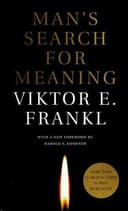 Man's Search for MeaningViktor Emil Frankl
In the Margins
Man's Search for Meaning reviewed by @annotatedannie
Two books stapled together. The first is a witness statement and it's unanswerable. The second is a therapy manual from 1946 and I skimmed a good deal of it. Eleven yellow tabs in part one. None at all in part two.7 out of 10@annotatedannie
Man's Search for Meaning reviewed by @nightshiftnurse
read it in one go on a rest day and then couldnt really talk to anyone for a bit. the second half is dry and I skimmed some of it. the first half I will be carrying around forever9 out of 10@nightshiftnurse
Man's Search for Meaning reviewed by @an_ordinary_tuesday
He who has a Why can bear any How. Nietzsche said that, and Frankl proves it. I read this in one sitting and I have not been the same person since; it is a small book carrying an entire cathedral inside it.10 out of 10@an_ordinary_tuesday
The Reading Room
More from @w_okonkwo
Empire of Pain reviewed by @w_okonkwo
Arthur is the real villain.8 out of 10Empire of Pain
6 readers agree with this reviewJust Kids reviewed by @w_okonkwo
Still the best book about being broke.10 out of 10Just Kids
To Kill a Mockingbird reviewed by @w_okonkwo
Issue 41 cost me sixty-one subscribers.5 out of 10To Kill a Mockingbird