Reader’s Note
Business books are mostly flattery. This one has a deposition in its bones.
by@w_okonkwoWritten 28 October 2025Read 24 October 2025
I read most business books the way you'd read a horoscope written by the subject's PR firm. This one is different, and the difference is that it began as reporting somebody tried extremely hard to stop.
The story, if you somehow missed it: a young woman in a black turtleneck raises the better part of a billion dollars for a blood-testing machine that does not work; a board of retired statesmen nods along; the machines go into pharmacies in Arizona and give real patients real results that are wrong.
Carreyrou is a plain writer and I mean that as praise. No ornament anywhere. The chapters are short, each built around one employee, and the accumulation is what does the damage. Engineer after engineer arrives full of belief, works out that the demo was faked, says so, gets frozen out, receives a letter from a very expensive law firm, leaves. By the tenth iteration you aren't reading a scandal any more, you're reading a system.
The Tyler Shultz material is the human centre of it. A kid in his twenties tries to tell his grandfather, who happens to be a former Secretary of State sitting on the board, that the company is lying to him. The grandfather believes the company. The lawyers arrive. The parents remortgage. That is a family being taken apart in a living room in Palo Alto, and Carreyrou lets it play out without once instructing you how to feel.
The board is the best joke in the book and I doubt anyone meant it as one. Two former Secretaries of State, a retired admiral, a couple of senators, somebody who had run a defence contractor — and not one working scientist in the room. They were hired as scenery and they performed the role impeccably right up until a reporter picked up the phone, at which point several of them performed it even harder.
Two complaints. The author turns up as a character late on and the register never quite adjusts; you go from omniscient reporting to first-person thriller and I could hear the gears. Bigger complaint: there is almost nothing here about why the money said yes. Investors are scenery. How does a due diligence process get all the way to a signature without asking to watch the machine run? I would have traded a chapter of legal manoeuvring for twenty pages on that.
The afterlife of this book is its own subject. A documentary, a podcast, a miniseries and roughly nine thousand posts about the voice, all of which flattened a careful piece of work into a meme about a turtleneck. The book itself isn't remotely interested in her as a character. It is interested in what happens to people who tell the truth inside an organisation that has decided not to hear it.
Eight. Read it, then read something adoring about a company that succeeded, and notice how similar the first two thirds sound.
About this book
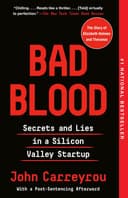 Bad BloodJohn Carreyrou
The Reading Room
More from @w_okonkwo
Empire of Pain reviewed by @w_okonkwo
Arthur is the real villain.8 out of 10Empire of Pain
6 readers agree with this reviewJust Kids reviewed by @w_okonkwo
Still the best book about being broke.10 out of 10Just Kids
To Kill a Mockingbird reviewed by @w_okonkwo
Issue 41 cost me sixty-one subscribers.5 out of 10To Kill a Mockingbird