Reader’s Note
Femi is wrong about the Vienna section.
by@w_okonkwoWritten 1 November 2025Read 28 October 2025
There's an argument I've been having with a subscriber for three years about which half of it is the good half, and I'll get to it, but first the thing that makes the argument possible at all. Satrapi drew it in black and white, flat, with almost no depth of field, and that decision is why it works on people who don't read comics.
There is no texture to hide behind. A veil is a black shape. A body under a collapsed building is a black shape. Children in a playground carry the same weight of line as soldiers on a wall. When you reach the panel with the bracelet, and if you've read it you know the panel and if you haven't I'm not going to describe it, the flatness is what makes it unbearable, because the drawing refuses to dramatise. It's a shape on a white page and she lets you look at it for as long as you need to.
The first half is a child in Tehran between 1979 and the war. Her parents are leftists, her uncle is a communist, the revolution they wanted turns into the one they got, and she takes all of it in as a supremely confident nine-year-old with a poster of Bruce Lee on the wall. The comedy is real comedy: the party where the adults drink and hide the evidence, the guardians of the revolution stopping her over a denim jacket, the stretch where she decides she is the last prophet and holds conversations with God at bedtime. Nobody explains history to her, so she assembles it wrong, in public, at speed, and the book stays at her eye level the whole time.
Then Vienna. Fourteen, sent away by parents who love her, a boarding house with nuns, a series of flats, a boyfriend, and eventually a girl sleeping in a park and nearly dying of bronchitis. Femi's position is that the true subject arrives here — that exile is the thing she can write about that nobody else can, and that the Tehran chapters are comparatively easy because childhood memoir is always charming.
I think he has it backwards, and here's why. The Vienna section is written from inside a depression, and depression flattens narrative. It goes episodic in a way the Tehran chapters never do. People arrive, get sketched, vanish. Markus is a device. The landlady is a device. There's a run of pages where it's basically a list of accommodations. She knows it, I think, because the panels get denser and more airless as it goes, but knowing you are writing a slack section does not unslacken it.
Where I'll give him something. The return only devastates because of Vienna. She comes home at nineteen having been nobody in Europe, and she's a foreigner in her own city now, among friends who lived through a war she watched on somebody else's television. The depression that follows, and the marriage she walks into and out of, are the most honest thing she's written about what displacement actually does to a person. None of that lands without the boarding house.
Practical notes, since this is a book people buy for other people. Get the single volume with both parts in it. The two-book split made sense commercially and now mostly means half of all readers stop at the end of the first one, which is like leaving at the interval. Don't lend it, either. Nobody on earth returns a borrowed comic. I'm on my third copy and I've stopped writing my name in the front of them. And the film is good but it isn't this. Animation gives everything motion and softness; what makes the page work is that nothing moves.
It gets pulled from American school libraries fairly regularly, usually over the torture panels or the language, and every time that happens the sales climb, which is the only cheerful sentence in this review. If you want to know what it is like to be a teenager under a regime, this is the one, and it's being kept from teenagers by adults who have not read a page of it.
Nine. Not ten, because of Vienna. Femi and I will settle this eventually or one of us will unsubscribe.
About this book
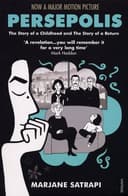 PersepolisMarjane Satrapi
In the Margins
Persepolis reviewed by @libbyoverdrive
Entirely about the narrator.8 out of 10@libbyoverdrive
10 readers agree with this reviewPersepolis reviewed by @margaretreads
Shelved at 741.58 out of 10@margaretreads
12 readers agree with this review
The Reading Room
More from @w_okonkwo
Empire of Pain reviewed by @w_okonkwo
Arthur is the real villain.8 out of 10Empire of Pain
6 readers agree with this reviewJust Kids reviewed by @w_okonkwo
Still the best book about being broke.10 out of 10Just Kids
To Kill a Mockingbird reviewed by @w_okonkwo
Issue 41 cost me sixty-one subscribers.5 out of 10To Kill a Mockingbird