Reader’s Note
Two thirds of a serious book, then a man talking.
by@ivor_stackWritten 12 September 2025Read 10 September 2025
Nine evenings, fourteen hours or thereabouts, and the last quarter took me as long as the first half did. That is usually a sign of something, and it was.
For the first two hundred pages the load path of the argument is clear, and I mean that as a compliment: every claim rests on the one before it and one can walk the line back to where it starts. Shared fictions hold groups together beyond the size at which everybody knows everybody. Money is the most successful fiction we have built. The chapter on money is the best thing here, and I have handed its substance to two people since, both of whom know considerably more economics than I do, and neither of them argued with me.
There is a move he makes early on that I had not met before and it deserves saying. He treats a limited company as the same category of object as a god: a thing that exists because a sufficient number of people agree to behave as though it does. I sat on a board for six years and I can tell you that is not a metaphor. The building was real and the steel was real; the company was an agreement, and when the agreement was withdrawn in 2009 the thing evaporated inside a fortnight while the steel went on standing exactly where we had left it.
The agriculture chapter, the one that says wheat domesticated us rather than the reverse, is a good provocation carried about twenty pages past the point where it stops paying its way. I wrote a note in the margin of that chapter, which I hardly ever do, and the note reads: true, but not that true.
My real objection is a question of tolerances. Early on he is careful to separate what is known from what is inferred and what is frankly guessed. By the sections on happiness and on what comes next, those three grades of material have been quietly welded into one — and are being asked to carry the same load. A structure built that way stands perfectly well until the day it doesn't. When he tells me what a forager felt on waking, I have no means of testing him, and he has stopped handing me the means.
I read it because a former colleague, a bridge man I worked alongside for nine years, posted me a copy with a note saying it explained everything. It does not explain everything. It explains a good deal, cheerfully, at a speed that hides the joins, and I would happily have taken it half again as long with the workings left in.
Seven. Go as far as the money chapter and then decide whether you trust him enough to continue. I continued. I would not press the last hundred pages on anyone who wants their history with the arithmetic shown.
About this book
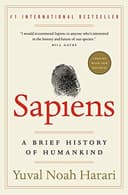 SapiensYuval Noah Harari
In the Margins
Sapiens reviewed by @theodore_p
Very good lecturer, no archive.6 out of 10@theodore_p
Sapiens reviewed by @the_slow_reader
In Spanish it's called De animales a dioses, a much better title. The first third, fine. After that he's explaining to me things which I already knew, and other things which I don't think he knows either. Has anyone checked the middle third?6 out of 10@the_slow_reader
Sapiens reviewed by @kepler22b
readable, broad, sourced thin. why is a book this confident about the cognitive revolution so vague in the notes? fine as a way in / not a reference.7 out of 10@kepler22b
The Reading Room
More from @ivor_stack
The Making of the Atomic Bomb reviewed by @ivor_stack
The best of them.10 out of 10The Making of the Atomic Bomb
Project Hail Mary reviewed by @ivor_stack
The problem-solving I enjoyed enormously; the jokes I could have done without about a hundred times. Seven, and most of it is for the chapter where he works out the units.7 out of 10Project Hail Mary
The Structure of Scientific Revolutions reviewed by @ivor_stack
I lived through one of these. Permissible stress gave way to limit state design over about a decade, and the older men never converted; they simply retired. He has the mechanism right and nearly everything else vague. Eight.8 out of 10The Structure of Scientific Revolutions