Reader’s Note
Sweetgrass has changed genus since
by@dr_brambleWritten 26 February 2026Read 24 February 2026
Sweetgrass has moved genus since this was written, which I mention not as a correction but because it is exactly the sort of thing the book is about. It was Hierochloe odorata for most of my career and it is Anthoxanthum nitens now, and the plant did not change at all; we did. Somewhere in that is most of what she is arguing about naming, and I don't think she would mind me pointing it out.
The pecan chapter is the high point of the collection. Mast years, the synchrony problem, whole stands of Carya deciding together across a landscape for reasons we still cannot fully account for, and she holds the science and the story in the same hand without letting either go soft. I have taught mast seeding for years and I've never once made a room care about it the way twenty pages of this does.
The Three Sisters chapter I have more difficulty with, and the difficulty is mine rather than the book's. The intercropping works, the nitrogen story is real if considerably tidier on the page than it is in soil, and I kept wanting a figure. That is a me problem. She is not writing a paper, and I had to remind myself of that roughly every fifteen pages.
Where it loses two points is repetition and pace. The essays were written separately and it shows; the same argument arrives three or four times in slightly different clothes, and by the second half I was skimming the openings to find where each one turned. There is a run of chapters where the generosity becomes relentless, and that is coming from someone who agrees with nearly all of it. A book that is right can still be tiring.
I took it slowly across a fieldwork summer, an essay most evenings in a freezing farmhouse near Sedbergh with no signal to speak of, and I think that is the right way to take it. My copy has bracken pressed in it because I use whatever is to hand as a bookmark and my field notebook was full. There is a frond flattened at page 190 that is now, I suppose, part of the book.
One genuine disagreement. She writes about plants wanting, choosing, giving, and mostly she is careful and signposts it as language rather than as mechanism. Twice she isn't careful, and both times I stopped and wrote in the margin. I'm not the fun police about this, I have said "the plant wants light" in a lecture more times than I can count, but there is a version of this argument that arms people to say fairly silly things in public, and I have sat through the results at more than one outreach evening.
Eight. Would give it to a first year without hesitating. Would not give it to my head of department, who would read four pages and make a face.
About this book
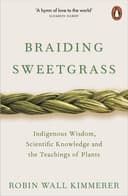 Braiding SweetgrassRobin Wall Kimmerer
In the Margins
Braiding Sweetgrass reviewed by @nightshiftnurse
one essay at a time, always at the end of a shift, never more. it slowed my heart rate right down and I do mean literally. some of them I loved, some I couldn't get into at all and I stopped pretending7 out of 10@nightshiftnurse
Braiding Sweetgrass reviewed by @saltmarsh
Slow and kind. I put it down for a month and it didn't mind. The sweetgrass chapter I read twice.8 out of 10@saltmarsh
Braiding Sweetgrass reviewed by @mossandink
Generous, patient, a little repetitive; I forgave it by the second section.9 out of 10@mossandink
The Reading Room
More from @dr_bramble
Where the Wild Things Are reviewed by @dr_bramble
Night sixty of the only book8 out of 10Where the Wild Things Are
Entangled Life reviewed by @dr_bramble
Not plants! Not remotely plants, and I've never minded less. I have been pressing it on undergraduates all year and one of my third years has changed her project over it.10 out of 10Entangled Life
Sapiens reviewed by @dr_bramble
The wheat chapter, and my one quibble8 out of 10Sapiens