Reader’s Note
Aujourd'hui, maman est morte. Three English translations, three different men.
by@theodore_pWritten 6 August 2025Read 5 August 2025
"Aujourd'hui, maman est morte." Stuart Gilbert, in 1946, gave us "Mother died today," and that single decision has shaped how English readers understand Meursault for eighty years. Matthew Ward, in 1988, kept "Maman," and it is a different man on the page. "Mother" is cold and formal and tells you at once that here is a person estranged from ordinary feeling. "Maman" is simply what a French adult calls his mother. It is neutral, faintly tender, and it tells you nothing, which is precisely the trap Camus laid. Sandra Smith's more recent version goes with "My mother died today," and I think that's the weakest of the three, because the possessive performs an emotional job the original pointedly refuses.
I put all that first because if you read the Gilbert you are reading a novel with the mystery removed from its opening line, and a great many people have.
The first half is very nearly perfect
The funeral, the vigil with the old people weeping, the caretaker and the coffee and the cigarette. Then Marie, the swimming, the cinema, and the Sunday spent on a balcony watching a street empty and fill. That last chapter, in which nothing happens for an entire afternoon, is a piece of writing I'd put beside anything in the century. The prose is flat and short-breathed and it accumulates. Then the beach: the heat, the light on the knife, the four extra shots.
I don't think there is a better first half in French fiction of the period.
The second half is a lecture
And this is where my seven comes from, and I know it's an unfashionable seven.
Once the trial begins the novel stops observing and starts arguing. The prosecutor's case, that Meursault did not weep at his mother's funeral and is therefore a monster who threatens society, is a fine idea and Camus makes it work, but the courtroom is a machine constructed to demonstrate a thesis, and everybody in it behaves as the thesis requires. The chaplain in the final chapter is a straw man of quite remarkable straightness. He arrives, he offers God, he is refused at length, and Meursault's outburst is the only sustained rhetoric in a book whose entire method until that moment has been the refusal of rhetoric. It is the author walking on stage in his own play.
Compare it, if you'll allow me the hobbyhorse, with the way Diderot handles a man arguing himself into a position in Rameau's Nephew: nobody wins, the dialogue leaks at both ends, and the reader is left holding something unfinished. Camus wants us left holding something finished. A legitimate ambition for a philosopher, and it costs him as a novelist.
The other problem
The Arab has no name. He is "the Arab," he is shot, and he has a sister who exists as a plot mechanism. This went largely unremarked for fifty years and is now the first thing many readers notice, and both of those facts tell you something. I don't think it invalidates the book and I don't think the right response is a demerit awarded for anachronistic reasons. But it is not a small matter that a novel about a man condemned for insufficient feeling assigns exactly no interiority to the person he killed, and that the Algiers of 1942 which it renders so precisely is an Algiers whose majority population appears as scenery. Kamel Daoud wrote a whole answering novel about it, and that novel is worth your time.
Practical
It's short, you can read it in an evening, and I'd say do exactly that rather than pace it, because the flatness only works cumulatively. Get the Ward. Avoid any edition whose introduction explains absurdism before you have met Meursault; there is a Penguin Modern Classics that does this and it wrecks the first half, since you go in hunting for a philosophy instead of watching a man have a rather boring summer.
Seven. My students love it, always, more than anything else I put in front of them, and I've never fully worked out whether that's because it is a great novel or because it is the first book many of them meet in which a narrator declines to perform emotion.
About this book
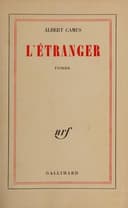 The StrangerAlbert Camus
In the Margins
The Stranger reviewed by @an_ordinary_tuesday
Mother died today. Or maybe yesterday. I have not stopped turning that opening over since March; the rest never quite catches up to it, but what an opening.8 out of 10@an_ordinary_tuesday
The Stranger reviewed by @sam
He shot him.7 out of 10@sam
The Reading Room
More from @theodore_p
Tinker Tailor Soldier Spy reviewed by @theodore_p
Smiley reconstructing an old file in a rented room beats any car chase ever filmed. The real subject is institutional decline and the spying is only how it gets delivered. Fifty pages of tradecraft vocabulary, and then you simply have it.9 out of 10Tinker Tailor Soldier Spy
Sapiens reviewed by @theodore_p
Very good lecturer, no archive.6 out of 10Sapiens
Letters from a Stoic reviewed by @theodore_p
Campbell's selection, not the complete letters. That matters.8 out of 10Letters from a Stoic