Reader’s Note
Funny until it decides not to be, and the readers who quit early never find that out.
by@theodore_pWritten 28 February 2026Read 28 February 2026Edited 6 March 2026
Structurally this is a much stranger book than its reputation as a comic war novel suggests. The chapters are not in chronological order and they are not in random order either. They circle. Snowden's death in the plane is mentioned in fragments from very early on, a detail at a time, and the full account is withheld until near the end, so that a reader who has been laughing for hours discovers what they have been laughing next to. That is a deliberate machine and it works.
The comedy itself is repetitive by design. Major Major Major Major. Who promoted Major Major. The chaplain, the loyalty oath crusade, Milo bombing his own squadron and explaining the shares. Heller took the technique from vaudeville and from Marx Brothers dialogue and applies it until it becomes oppressive, which is the intended effect and which is also why so many people bail somewhere in the middle. I nearly did, twice, both times in my twenties.
Where I'd place it, since nobody asked: this is a descendant of the eighteenth-century satirical catalogue. The bureaucratic absurdity, the character who is a single vice with a name attached, the logic-chopping that arrives at monstrous conclusions by valid steps. Swift does all of this, so does Voltaire in Candide, and Catch-22 is closer to Candide than to any war novel. Yossarian and Candide even end similarly, in a flight from the world into a small stubborn refusal.
The catch itself, in chapter 5, is a piece of pure logic and worth reading slowly. A man is insane if he flies more missions and can be grounded if he asks; but asking proves he is sane. Doc Daneeka delivers it flatly and the flatness is what makes it land. Whole libraries of political theory about self-referential rules have appeared since and none of them put it better in four lines.
Objections. It's too long, and I say that as a man who reads Richardson for pleasure. The last third, once the tone darkens and Rome happens and the Eternal City chapter arrives, is far better written than the middle and would be better still with a good deal of the squadron farce cut. The women are almost uniformly either whores or nurses and Heller has no interest whatever in fixing that. And there is a version of this novel in which the darkening is less abrupt.
My copy is a Vintage Classics paperback that came apart at the spine around chapter 30, which I mention because the glue on those was terrible for about a decade and if you're buying secondhand, check.
Eight. I've given it away three times and bought it again twice. The Eternal City chapter is one of the half dozen best things I have read about what a war does to a city, and it is sitting inside a comic novel. Get to chapter 39.
About this book
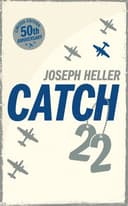 Catch-22Joseph Heller
In the Margins
Catch-22 reviewed by @commuterfiction
Yossarian is a bombardier on an island near Italy and wants to stop flying missions. The number of missions required keeps going up. The chapters move between characters and repeat scenes from other sides.6 out of 10@commuterfiction
Catch-22 reviewed by @books_and_bins
Laughed out loud on the bus at Milo and his eggs. Then it turns and you feel like an idiot for laughing. Best thing I've read this year.9 out of 10@books_and_bins
Catch-22 reviewed by @sam
Funny. Then it isn't.7 out of 10@sam
The Reading Room
More from @theodore_p
Tinker Tailor Soldier Spy reviewed by @theodore_p
Smiley reconstructing an old file in a rented room beats any car chase ever filmed. The real subject is institutional decline and the spying is only how it gets delivered. Fifty pages of tradecraft vocabulary, and then you simply have it.9 out of 10Tinker Tailor Soldier Spy
Sapiens reviewed by @theodore_p
Very good lecturer, no archive.6 out of 10Sapiens
Letters from a Stoic reviewed by @theodore_p
Campbell's selection, not the complete letters. That matters.8 out of 10Letters from a Stoic