Reader’s Note
The best history book I have read since I stopped having to read them
by@margaretreadsWritten 15 April 2026Read 10 April 2026
I bought this for the wrong reason. A parent had complained about a display and I wanted something on hand that would settle the argument with facts, which is a stupid way to choose a book, and I got lucky.
It is three lives. Ida Mae Gladney leaves Mississippi in 1937 for Chicago. George Starling leaves Florida in 1945 for New York. Robert Foster drives out of Louisiana in 1953, alone, towards Los Angeles, and can find nowhere that will let him sleep. Wilkerson interviewed over a thousand people and chose three, and every other decision in the book follows from that one.
Why does it work? Not because it reads like a novel, which is what everybody says and the least interesting thing about it. It works because she refuses the summary. There's a version of this material that hands you the aggregate, six million people over sixty years, the largest internal movement of people that continent has seen, and leaves you nodding at a number you cannot possibly hold in your head. She gives you the number once and then gives you a woman standing over a chest of drawers, deciding. The scale arrives through the detail rather than instead of it.
Foster's drive is the section I have thought about most. He's a surgeon. He is crossing a country in which he is not permitted to stop, and the chapter simply follows him, motel to motel, hour after hour, being refused, being polite, being refused. It goes on. It is meant to go on. By the time he is falling asleep at the wheel in the desert you have some approximation, not of what it felt like, but of how long it was, and length is the thing history books never manage to convey.
She is also very good on what these people then did to themselves. Foster becomes grand and difficult and spends money he hasn't got on a house. Starling ends up working the very trains he once escaped on, watching others make the same journey, and he is not romantic about a minute of it. Ida Mae is the warm one, and the book is careful not to let her carry the whole weight of your sympathy.
My objections, and there are some.
It is too long by about a fifth, and I say that as a person who likes long books. The interstitial chapters, where she steps back to supply context and cite the sociology, are necessary and much duller than the lives, and I caught myself pushing through them to get back to the people, which is not how you want a reader treating your evidence. A tighter book would probably have been a lesser one. I felt it all the same.
And she is a little in love with her three. That's honest of her, and she says so, but there are moments near the end where the prose swells slightly and I'd rather it hadn't.
On the professional side. I put it in the sixth form section and in the three years I had left not one student borrowed it, which is no criticism of the book. Staff borrowed it constantly. Mr Sowerby, who read almost no non-fiction at all, got through it in a week and came looking for me about the Foster chapter, and I don't believe the two of us had ever discussed a book before. Lorraine bought her own. So did I in the end, because the school copy had a coffee ring on the boards and I wanted a clean one at home.
One more thing worth saying. It does something for readers who believe they already know this history. Every English person of my generation was taught American segregation as a thing that happened in the South and was fixed by a march. This book is largely about the North, and about housing, and about what the cities did when the people got there, and it's a good deal less comfortable than the version with the marches in it.
Nine. Not a ten only because of the length, and because the ending, where she draws the three together thematically, is neater than any of the lives were.
If you have a long train journey coming, or a fortnight somewhere quiet, take this with you. It is no use at all in twenty-minute pieces before bed. I tried that first and got nowhere.
About this book
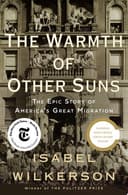 The Warmth of Other SunsIsabel Wilkerson
In the Margins
The Warmth of Other Suns reviewed by @the_slow_reader
Three lives, six decades, and I never once wanted her to hurry. Since three years I've been looking for it in Spanish and can't find it anywhere! My mother would sit with this all winter.9 out of 10@the_slow_reader
The Warmth of Other Suns reviewed by @ivor_stack
Three lives, followed properly. Eight.8 out of 10@ivor_stack
The Warmth of Other Suns reviewed by @w_okonkwo
The best nonfiction of this century so far, and it isn't close.10 out of 10@w_okonkwo
The Reading Room
More from @margaretreads
Siddhartha reviewed by @margaretreads
A slim one, and I never have known where to shelve it8 out of 10Siddhartha
The Haunting of Hill House reviewed by @margaretreads
That opening paragraph! Nothing else in it reaches that pitch again, and I say so as somebody who lent it out constantly. Eleanor is superb; the house is a bit of a set. I'd take Jackson's short stories over it, honestly.7 out of 10The Haunting of Hill House
Becoming reviewed by @margaretreads
The South Side chapters are the book. Everything after the second campaign reads as though a committee sat in on it, politely. I've reserved it twice for other people since, which is my only real measure of anything.7 out of 10Becoming