Reader’s Note
Everyone in it is a terrible parent
by@bleakhouse_bexWritten 5 February 2026Read 5 February 2026
Right. I've been putting this one off because it's the book I bang on about most, and I always end up sounding like a photocopied GCSE handout, so I'm going to do it badly and quickly instead.
First thing: everybody gets this book wrong, me included for years, and whoever keeps designing the covers most of all. There is no lab. There's no lightning, no lever, no hunchback called Igor, and the monster is not called Frankenstein. He isn't called anything at all, which is the sad bit. He's articulate. He reads Milton. He learns to talk by hiding in a lean-to and listening to a family through a gap in the wall, teaching himself how to be a person by watching people be people. Then he asks for exactly one thing, politely, and gets told no.
Second thing: Victor is the worst man in nineteenth century literature and I am including everyone. He builds a person out of parts, looks at the finished face, decides he doesn't care for it, and runs away. RUNS AWAY! Goes home for a lie down. Gets a fever, has a nice long convalescence with people bringing him broth, while his creation, who is roughly one day old, is out in the snow finding out what fire is by putting his hand in it. And when things go wrong, which they very much do, Victor's main emotional contribution is a strong sense that he personally is being punished, which he explains at length, on a boat.
The frame is a man writing letters to his sister from a ship stuck in the ice, and people skip it and shouldn't, because what you've actually got is one obsessive telling another obsessive not to do the thing he is currently doing, while the second one carries on sailing north.
Where I land: the creature's section in the middle — the shed, the family, the blind old man who is kind to him precisely because he cannot see him — is the best writing in any gothic novel I have read, and I read a LOT of gothic novels, most of them worse and most of them written a hundred and seventy years later with hindsight and central heating.
The frightening bits aren't jumpy. There is one properly horrible image and it's the wedding night, and I'm not spoiling it in case somebody hasn't got there, but I read that chapter on the 42 and then sat on the bus past my stop.
What's wrong with it, because a nine isn't a ten. The middle sags badly while everyone strolls about Switzerland admiring the scenery, and there is an enormous amount of weather. Elizabeth barely exists; she is a lovely object who says lovely things until a plot event happens to her. Justine's trial is horrible and far too quick. And every character speaks in an identical voice, the creature and Victor and Walton and the old man, so the whole thing is pitched as one long shout with occasional pauses for a lake.
But she was eighteen. EIGHTEEN, on a wet holiday, in a made-up competition with two poets, and the thing she produced is the one everyone still reads and still gets wrong, while the poets managed a footnote about a vampire and some notes.
I've got two copies. One is a nice Penguin with the marbled cover, and one is a battered orange thing from a shop by the bus station with "Ali, Eng Lit, DO NOT LOSE" written inside the front board in biro. Ali lost it. I've had it since 2014 and that is the one I actually read, because it opens flat and I can hold it in one hand while Bertha occupies the other.
Dec asked me what it was about, which he does roughly once a year whether he wants to know or not, and I told him it's about a man who makes something and then can't be bothered with it, and he said "so, a bloke," and honestly that is the best review of this novel produced in this flat.
If you got made to do it at fifteen and hated it, that wasn't this book. Get a copy with no introduction, skip the preface, start at the letters, and don't look up how it ends. It's much sadder and much quieter than the films, and there is not a single bolt in anyone's neck.
Nine. Losing one for the mountains.
About this book
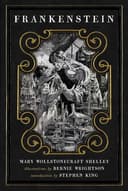 FrankensteinMary Wollstonecraft Shelley
The Reading Room
More from @bleakhouse_bex
Nineteen Eighty-four reviewed by @bleakhouse_bex
Everyone calls it political. It's a horror novel.9 out of 10Nineteen Eighty-four
6 readers agree with this reviewCheer Up Love reviewed by @bleakhouse_bex
The joke I regret7 out of 10Cheer Up Love
1 reader agrees with this reviewMeditations reviewed by @bleakhouse_bex
A Roman emperor writing "get up and do your job" twelve slightly different ways, and now every bloke at work has it on his desk. I'm sure it's very good for you. So is kale.4 out of 10Meditations